Project Case Study
Grid Typography Generator
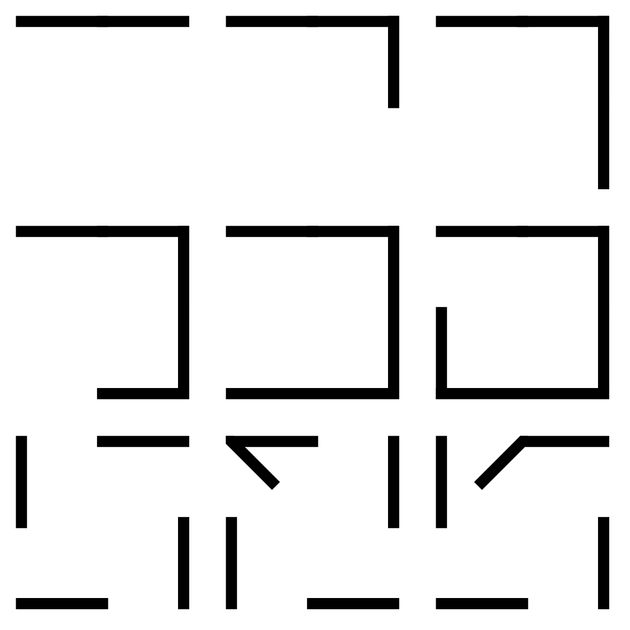
A combinatorial system that generates all possible variations of a modular typographic grid by treating visual segments as binary states.
The Concept
Wouter Pollaris developed a system to explore the complete possibility space of a modular typographic grid. The core idea: decompose a visual grid into discrete segments, then generate every possible combination of those segments being present or absent.
Rather than manually designing variations or randomly sampling, this approach exhaustively enumerates all 2^n configurations. For 28 segments, that yields 268,435,456 unique compositions—a complete atlas of what the grid can become.
System Overview
The system operates on three levels:
- Segment Library — Individual SVG files, each containing one geometric element (a bar, line, or corner piece) positioned on a shared coordinate system
- Alternate Segments — Special segments that replace combinations when certain elements appear together (handling visual collisions)
- Generator — A Python script that iterates through all binary combinations and assembles valid SVGs
The segments were designed in Adobe Illustrator and exported as individual SVG files. Each file contains a single <rect> or <polygon> element positioned within a 510×510 pixel canvas.
Core Mechanisms
Segment Structure
Each segment file follows a naming convention that encodes its identity and relationships:
| Pattern | Meaning |
|---|---|
grid-N.svg |
Base segment N |
grid-N+M.svg |
Alternate for when segments N and M both appear |
grid-N+M+P.svg |
Alternate for three-segment combination |
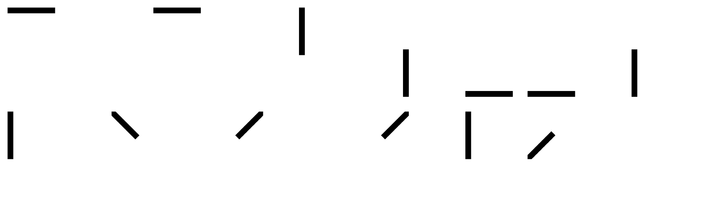
A base segment is a simple rectangular bar:
Base segment (grid-1.svg)
<g id="Laag_1">
  <rect x="28.346" y="28.346" width="240.945" height="28.346"/>
</g>
An alternate segment replaces colliding elements with a merged form:
Alternate segment (grid-1+9.svg)
<g id="Laag_1">
  <!-- Merged corner shape instead of two overlapping bars -->
  <polygon points="269.291,28.346 269.291,56.686 36.641,56.686
                   28.351,48.396 28.351,28.346"/>
</g>
Binary Enumeration
The generator treats each segment as a bit in a 28-bit integer. Segment 1 maps to bit 0, segment 2 to bit 1, and so on. This allows iteration through all combinations using a simple counter:
Bit extraction logic
segment_count = 28
possible_combinations = int(math.pow(2, segment_count))

for i in range(0, possible_combinations):
    segment_ids = []
    for j in range(0, 28):
        # Extract bit j from number i
        if (i >> j) & 1 == 1:
            segment_ids.append(j + 1)
When i = 100 (binary: 1100100), segments 3, 6, and 7 are active. When i = 255 (binary: 11111111), segments 1–8 are active.
Collision Resolution
When certain segments appear together, they would overlap visually. The system detects these cases and substitutes a merged alternate:
Alternate detection and substitution
# Build set of known alternates from filenames like "grid-1+9.svg"
alternate_segment_set = set([find_segment_list(f) for f in alternate_files])

# Check all 3-segment combinations in current selection
for combo in itertools.combinations(segment_ids, 3):
    if combo in alternate_segment_set:
        # Replace lowest-numbered segment with the combined form
        lowest_segment_id = combo[0]
        idx = segment_ids.index(lowest_segment_id)
        segment_ids[idx] = combo  # Now a tuple, handled specially

# Same for 2-segment combinations
for combo in itertools.combinations(segment_ids, 2):
    if combo in alternate_segment_set:
        lowest_segment_id = combo[0]
        idx = segment_ids.index(lowest_segment_id)
        segment_ids[idx] = combo
The substitution replaces the lowest-numbered segment ID with a tuple representing the combined form. During assembly, tuples trigger loading the alternate file.
SVG Assembly
Each output is assembled by concatenating segment content into a single SVG:
Output generation
SVG_HEADER = '<svg xmlns="http://www.w3.org/2000/svg" ' \
             'width="524.409px" height="524.409" viewBox="0 0 524.409 524.409">'
SVG_FOOTER = "</svg>"

svg = SVG_HEADER
for segment_id in segment_ids:
    if isinstance(segment_id, tuple):
        # Alternate segment: join IDs with "+"
        ids = "+".join([str(sid) for sid in segment_id])
        segment_file = f"segments/grid-{ids}.svg"
    else:
        segment_file = f"segments/grid-{segment_id}.svg"

    segment = read_segment(segment_file)
    svg += segment

svg += SVG_FOOTER
The read_segment function extracts the inner content from each segment file, stripping the XML declaration and outer <svg> wrapper:
Segment extraction
def read_segment(file):
    with open(file) as fp:
        xml = fp.read()
        # Remove namespace to avoid duplication
        xml = xml.replace('xmlns="http://www.w3.org/2000/svg"', "")

    root = ET.fromstring(xml)
    first_child = list(root)[1]  # Skip empty <g id="back">
    return ET.tostring(first_child, encoding="unicode")
Output Structure
The generator produces 1,024 SVG files (the project was run with a reduced segment count for iteration):
out/
├── out-0.svg      # Empty (no segments active)
├── out-1.svg      # Only segment 1
├── out-2.svg      # Only segment 2
├── out-3.svg      # Segments 1 and 2
├── out-255.svg    # Segments 1–8 (outer frame)
├── out-511.svg    # Segments 1–9
└── out-1023.svg   # Segments 1–10
Each filename encodes its binary configuration. out-255.svg (binary 11111111) produces the complete outer frame:

Technical Notes
Coordinate system: All segments share a 510.236×510.236 point canvas (Adobe Illustrator's default). The output canvas is slightly larger (524.409) to accommodate margins.
Rotation handling: Many segments use SVG transform matrices for rotation. The system preserves these transforms during extraction:
<rect x="347.244" y="134.646"
      transform="matrix(6.123234e-17 -1 1 6.123234e-17 318.8976 616.5355)"
      width="240.945" height="28.346"/>
Scalability: With 28 segments, full generation produces 268 million files. The project uses tqdm for progress indication during long runs.
File naming: The find_segment_list function parses filenames to extract segment relationships:
def find_segment_list(file):
    # 'segments/grid-1+10.svg' → (1, 10)
    file = os.path.basename(file)           # grid-1+10.svg
    file = os.path.splitext(file)[0]        # grid-1+10
    file = file.split("-")[1]               # 1+10
    file = file.split("+")                  # ['1', '10']
    file = [int(f) for f in file]           # [1, 10]
    return tuple(file)                      # (1, 10)
Working Method
- Design segments in Illustrator on a shared artboard
- Export each segment as a separate SVG with consistent naming
- Identify collision pairs where segments overlap and design merged alternates
- Name alternates using the
N+Mconvention - Run generator to produce all combinations
- Review outputs to identify missing alternates or visual issues
- Iterate by adding new alternates as needed
The alternate system allows progressive refinement: start with base segments, run generation, identify problems, add alternates, repeat.
Outcome
The system produces a complete catalog of grid configurations that can be:
- Browsed visually to discover unexpected compositions
- Filtered programmatically based on segment count or specific combinations
- Used as source material for animation (interpolating between configurations)
- Extended with additional segment layers
The binary encoding means any configuration can be recalled by its index number, and relationships between configurations are mathematically explicit (adjacent numbers differ by one segment).
Wouter Pollaris conceived and designed this typographic exploration system. Code Space provided technical coaching on the combinatorial generation approach and SVG manipulation.